Bamidbar (Numbers 1:1-4:20)
From the Weekly Parsha Column, Ascent Lights, Contemporary illuminations from the director of Ascent-of-Safed, on www.KabbalaOnline.org.
by Rabbi Shaul Yosef Leiter
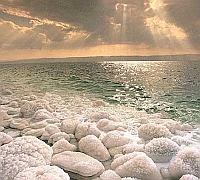
" Bamidbar" is both the name of this week's Torah portion as well as the name of the entire fourth book of the Torah that will carry us into the holiday of Shavuot and through much of the summer months, when we venture out on vacation. Bamidbar begins, "And G-d spoke to Moses in the desert [in Hebrew, 'midbar'] of Sinai...." Though called in English the "Book of Numbers", the Hebrew word "bamidbar" actually means "in the desert". A desert is, at least at face value, not a pleasant place, a place where negative forces have a stronghold, as the verse says, "[A desert is a place of] snakes, and vipers and scorpions and thirst, where there is no water" (Deut 8:15).
Rabbi Naftali of Ropshitz says that a desert actually can be used to demonstrate the strength of the Torah. The message of the Torah is so powerful that is can reach even the lowliest places at their most abysmal point, and from there the Torah is able to elevate everything. Rabbi Naftali emphasizes that this refers to every place and person, even those individuals who see themselves as too far away, too entrenched to be affected.
" ....get rid of the old baggage."
From the prophets and Talmud we learn that we should read Bamidbar between last week's portion of Bechukotai and the holiday of Shavuot. To accomplish this, the calendar has to sometimes be adjusted. The reason is because Bechukotai has a very long and fierce section of warnings to the Jewish people of the consequences for not following the Torah. On Shavuot we receive the Torah every single year anew, and so the message should be that we should let the old year and its curses go before beginning a new year. We do this by using Bamidbar as a separation between Bechukotai, the portion with curses, and the holiday of Shavuot in Sivan. Only in certain years, like the present one, the following Shabbat with the portion, Naso, may also fall just before Shavuot. Nevertheless, the lesson is clear. When you are about to begin something new prepare yourself properly, get rid of the old baggage. Making the effort to see things with a positive perspective will guarantee that you maximize the experience.
" Sadness is the greatest obstacle to imbuing the Divine Presence within each of us...."
Rabbi Elimelech of Liszensk comes to this idea in a different way, by focusing on the word "Sinai" in the first verse. The Midrash tells us that though Mt. Sinai was a mountain, it was the smallest mountain in the region. This is to teach us that just as G-d disregarded the high mountains, a Jew is supposed to be humble, and where spiritual growth is concerned, we always have a long way to go. Still, Mount Sinai was a mountain, a hint that it is forbidden to see ourselves as utterly hopeless, because this could lead to a person becoming sad. Sadness is the greatest obstacle to imbuing the Divine Presence within each of us. This is the reason that the Torah commands us that while we are supposed to feel lowly, we also always must be happy, just like a person who is lacking things but still feels happy at a special event or a holiday. This command to be happy is hinted in the continuation of the verse "...and G-d spoke to Moses in the desert of Sinai, from the tent of meeting [in Hebrew, 'mo'ed']". The word "mo'ed" literally means "an appointed time" and is consistently used to refer to holiday celebrations. When will G-d be revealed to us? First, in the "Sinai Desert", when we feel we have a lot of work to do, but also when we are in the "Tent of Moed", a place of festivity , when we feel happy.
We find in the writings of the Tzemach Tzekek, the 3rd Rebbe of Chabad, a very nice twist. There is the desert of unholiness, as we discussed above, and there is also the desert of holiness. The desert of holiness is when a person feels thirsty for G-dliness all of the time, wanting to connect, never satisfied. When we begin Bamidbar, a person should expect himself to be in a desert of holiness, always hungry for Torah.
Shabbat Shalom, Shaul
Reprinted with the permsission of www.kabbalaonline.org and www.ascentofsafed.com. To learn more about the Kabbalistic and Chasidic insights on the Weekly Parsha, please visit their sites.